
| London Town Guide |
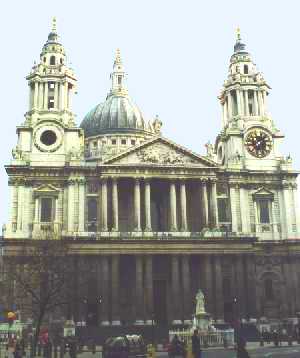
St Paul's Cathedral
Ludgate Hill, EC4
Tel: 020 7248 4619
Nearest Tube: St Paul's
|
|
|
|
Further up is the Stone Gallery (5), which is on the exterior of the dome. Even though the cathedral is over 250 years old, this site still offers one of the best views over London. But even better is the view from the third gallery, the Golden Gallery. (5) The climb takes you inside the structure of the dome (7) where you can admire Wren's architectural genius. And just before you reach the top there is a peephole, which you can look down through to the floor of the cathedral below to see just how high you have climbed - not for the faint-hearted!
There aren't as many tombs of famous figures in St Paul's as there are in Westminster Abbey, but there are still several well-known people buried or commemorated in the cathedral. Whilst Westminster Abbey is largely predominated with burials and monuments of royalty, statesmen and poets, St Paul's tends to be associated with military figures, architects and painters. It is in the South Transept (8) you will find Artists Corner with monuments to Turner, Hunt and van Dyck amongst others. And all around the cathedral are monuments to military commanders.
All burials are in the Crypt (9), which is the largest in Europe, and it is here that Christopher Wren himself is buried. And among others, you can also see the tombs of two of Britain's most famous military heroes - Nelson and Wellington.
Next to the Crypt (9) is the treasury (9) where there is a display of the rich religious paraphernalia of St Paul's including the embroidered robes of the bishops and the church plate. There is also an excellent exhibition on the history of the cathedral, which includes a model of the old St Paul's and some of Wren's original plans.
When Britain's former Prime Minister, Winston Churchill died in 1965 he lay in state in St Paul's while millions paid their respects - a plaque beneath the dome (7) marks the place where he lay. And of course, St Paul's has been the venue of several celebrity weddings, most notably the Royal wedding of Charles and Diana in 1981.
The cathedral is open daily, but there is an admission charge if you want to go inside. There are both recorded tours and guided tours available.
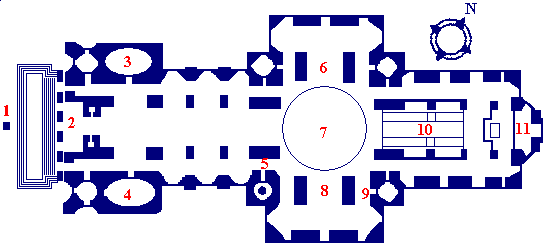
| 1 | Statue of Queen Anne | 7 | Dome |
| 2 | Main Entrance | 8 | South Transept and Artists Corner |
| 3 | St Dunstan's Chapel | 9 | Entrance to Crypt and Treasury |
| 4 | Chapel of St George and St Michael | 10 | Choir Stalls |
| 5 | Entrance to the Dome and Galleries | 11 | American Chapel |
| 6 | North Transept |
|
Copyright © 1995 to 2016 Smooth Hound Systems
Smooth Hound Systems accepts no liability with regards to the accuracy of the information on this site.
Users are advised to double check information such as dates, times, prices etc.